
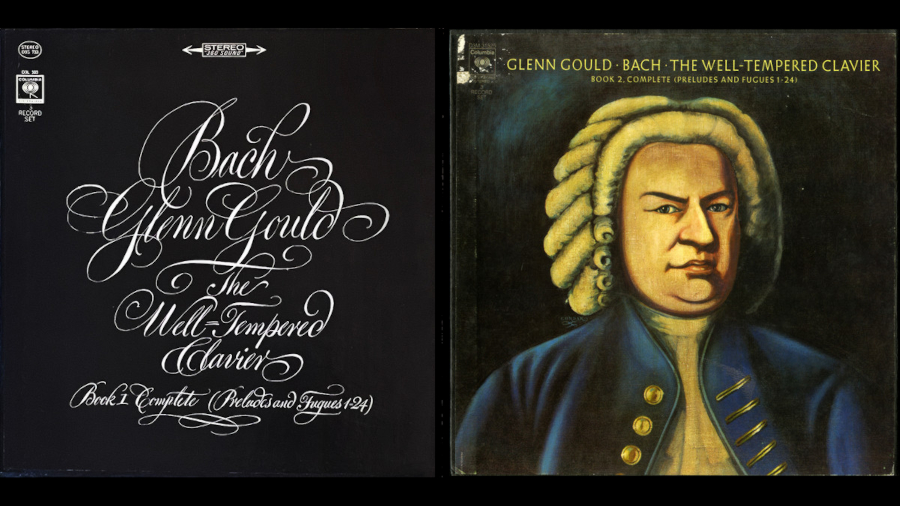
I'm Canadian, and of a certain vintage, so Glenn Gould is kind of synonymous with Johann Sebastian Bach in my mind. This is what I grew up with, and it is how I expect Bach to sound on the piano. Make no mistake, I love so many other performances just as well – Pierre-Laurent Aimard, Andras Schiff, Sviatoslav Richter, Angela Hewitt all leap to mind - but these two boxed sets are the recordings that I started with; they are the reference.
Indeed, Gould, Canada’s homegrown musical phenomenon was everywhere in the 1960s and 1970s; he was a source of pride, fascination, and some consternation because, after all, he was a fairly eccentric man and not ashamed to be eccentric in public. He retired from live performance in 1964, believing that he could only attain the perfection of performances in the studio (with significant retakes and editing, but he was also a frequent presence on the Canadian Broadcasting Corporation, producing radio and television documentaries on subjects on music and culture.
He was a national celebrity when I was growing up and, inevitably, an essential component of my early musical education. My first real introduction to the music of Bach was through Gould’s 1955 recording of the Goldberg Variations (which I have on CD) and these boxed sets of the two books of the Well Tempered Clavier. That was reinforced by my grade school music (and violin) teacher, Andreas Gutmanis, who used the Well Tempered Clavier to explain and demonstrate the 12 major and 12 minor keys.
That, of course, was the whole point of the Well Tempered Clavier. Bach had intended it, at first, in any event, to demonstrate a keyboard tuning system that would allow a keyboardist to play in any of the 24 diatonic keys without any key sounding less in-tune than any other. That was kind of a big deal in the 1720s and 1730s, when Bach composed these works; traditional keyboard tuning systems that privileged keys like C Major and D minor, tended to sound sour in some of the more remote keys, like D Major and F minor. The great composer set out to demonstrate, with a collection of Preludes and Fugues, that a “well-tempered” keyboard instrument (klavier) could sound just as good in G-sharp minor as it did in C Major. Twice.
Bach was also a pedagogue, of course, and one of the virtues of publishing two books, each containing 24 short Preludes and Fugues in every possible diatonic key, is that they could be used to teach piano with widely-varying levels of difficulty. Indeed, the First Book’s C Major Prelude (arguably the easiest) is my warm-up piece when I sit down at the piano.
By recording both complete cycles, Gould was not only demonstrating the brilliance of Bach, which cannot be gainsaid, but also demonstrating his own mastery of the keyboard and fugal counterpoint, and his ferocious virtuosity. And these are great performances, perhaps even definitive performances (although I am still struggling with that one), so much so that NASA included Gould’s recording of the Prelude and Fugue in C Major from the Second Book on the Voyager spacecraft’s golden record.
If aliens with a decent turntable someday intercept the Voyager probes, Gould’s performance will be one of the first things that they encounter of human civilization and, you know what, I’m okay with that. Listening to this music, they’ll come away with a much higher opinion of humanity than I believe we deserve.
These performances aren’t perfect. One of Gould's many eccentricities is that he hummed a counterpoint to whatever music he was playing and, notwithstanding his studio perfectionism, he insisted that the sound engineers leave it in. His humming is a bit much at times (especially on his recording of Bach’s Two and Three Part Inventions), but it is at least tolerable here, particularly if you aren’t listening in headphones.
Gould recorded both cycles on his favourite piano, Steinway CD 318, which he had found backstage at the Eaton Auditorium in Toronto in 1960, slated for disposal. It was in pretty bad condition at the time, with worn-out action, hammers, and felt that gave it none of the richness one normally associates with a top-of-the-line Steinway. And that is why Gould loved CD 318 – it sounded percussive and dry, more like a harpsichord that a modern piano. And that was the sound that he wanted for Bach.
From a Gramophone review of a reissue of Gould's Well Tempered Clavier Book II: "As many reviewers at that time enthused, it was a remarkable achievement, yet the carefully calculated and emotionless end-product, together with a lacing of inexplicable idiosyncrasies and the irksome vocal contribution, added up to an analytical exposition of Bach's music, rather than a human performance of it and one that was as often quirky as it was revelatory." Critics be critics.

0 Comments