
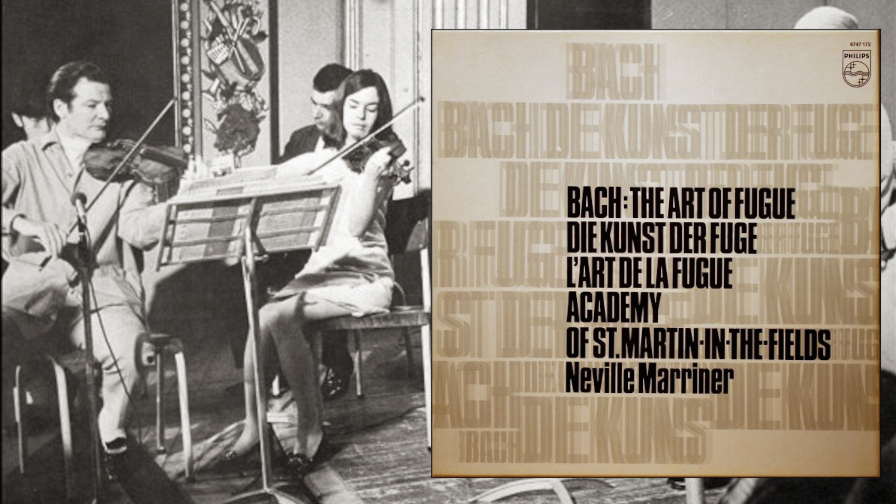
This record really kindled my love of Bach and inspired me to study music history. I remember the night my dad brought it home after work in 1975 and then the experience of listening to it for the first time. (You can read the whole story here.) My father was not a formally-trained musician, but he understood music better than anyone I have ever met, and he was self-educated in music theory – he had read Johann Josef Fux’s Gradus ad Parnassum from his POW camp’s makeshift library during the War. And he used this record to teach me counterpoint.
I can find little to fault here; it is nigh perfect, and I say this as someone with a deep interest in historically-informed performance practice (HIP). This is no HIP recording, but it is so full of life, fire, and introspection that it more than makes up for it. And, after all, what could a strict HIP performance of a work in open score, with no indicated instrumentation even sound like? Bach almost certainly meant the Art of Fugue as a keyboard work, but with no context or additional information, it is what Christian Wolff (the composer, not the philosopher) called “indeterminate.”
Neville Marriner and Andrew Davis prepared the performance transcription from the urtext, with different movements played by a smallish chamber orchestra, harpsichord, and chamber organ. And… It works: the instrumentation choices illuminate each fugue beautifully, culminating in one of the greatest, and most heartbreaking, performances of the Fuga a 3 Soggetti. The transcription has proved to be very influential, as some subsequent recordings (notably Reinhart Goebel’s HIP recording, which I have on CD and listen to often) have adopted the varied approach to their own arrangements.
I don’t know if this is merely an emotional judgment, based on what this recording means to me, but I can find no fault here. The performance (with Christpher Hogwood on the harpsichord and Davis on the organ) is precise and transcendent. Bach wrote for the “Castle of Heaven,” as John Eliot Gardiner wrote in his brilliant book on the composer, and I can hear it here – in all performances of the Art of Fugue, but especially in this one in all of its glory.
This might be my favourite record in my library. It is so much a part of why I love music and made it my life. This is not the actual boxed set that my father brought home when I was 11. That still exists, but it is in my brother’s possession for safe-keeping, a family heirloom that has been played a thousand times over the last half-century.

0 Comments